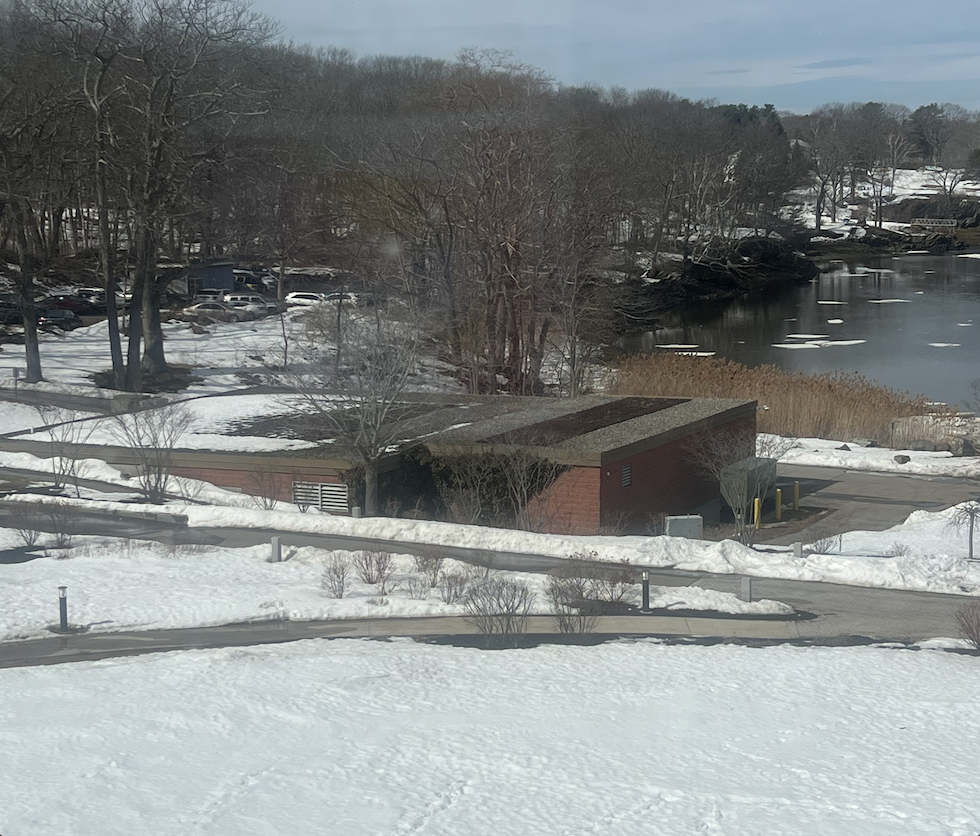
The Most Important Place on Campus You’ll Never Visit
It may not look very nice or smell very good, but the wastewater treatment plant is one of the most important places on the University of New England campus.
By: Mikayla Hill
Most students at UNE probably don’t think about what happens after they flush the toilet, take a shower, or wash dishes. It’s something we do every day without giving it a second thought. But that water doesn’t simply disappear. Instead, it travels through a system that eventually leads to UNE’s own wastewater treatment plant, where it is cleaned before being released back into the environment.
Many students don’t even realize that UNE has its own wastewater plant. Unlike many colleges that send their wastewater to a city treatment facility, UNE treats its water right here on campus. Every time students use water in dorms, labs, bathrooms, or kitchens, that wastewater ends up at the plant.
“We treat 80,000 gallons a day, and the water comes from kitchens, bathrooms, labs, and sinks,” said Tim Baker, a contractor at UNE who works with the wastewater system.
That amount of water adds up quickly when all the students that live and study on campus are taken into consideration. Thousands of gallons of water are used every day. Without proper treatment, that water could harm the environment.
The treatment process itself is very interesting. A lot of people might think it involves complicated chemicals or machines, but the system relies on bacteria in nature.
“It’s a biological system that uses the same bacteria that you find in nature. If you walk up a stream in your bare feet and feel all that slimy stuff on the rocks, it’s the bacteria we’re using here,” Baker explained.
Those bacteria help break down waste and organic material in the water. During the treatment process, solids are filtered out, bacteria break down the remaining waste, and the water is disinfected before it is released back into the environment. The goal is to make sure the water leaving the plant is safe and clean.
While the system is designed to handle a lot, there are still limits to what it can process. Some materials cause major problems for the wastewater system.
“Paper, plastic, chemicals and things like that can pass through the system, but students should be taking it easy on what they put down the drain. We have seen it all, phones, condoms, female products, gloves, and trash” Baker said.
Items like these can clog equipment, slow down the treatment process, or damage parts of the system. Even things labeled “flushable,” like certain wipes, can create issues once they reach the plant. “A big thing nowadays is flushable wipes like baby wipes, personal wipes, and cleaning wipes are all flushable but once they go through the toilet is when it creates a problem” Baker said.
Students might not think that what they flush or pour down the sink matters, but it actually has a direct impact on how well the treatment process works. The bacteria used in the system are sensitive, and harmful chemicals or large amounts of waste can disrupt the natural process that helps clean the water.
Some UNE students have had the chance to see the plant in person through environmental science classes. For many of them, the experience is both eye-opening and memorable.
“We went to the poop plant for my environmental issue class, and it was really interesting even though it smelt terrible,” said Juliana Dunn, class of 2029 majoring in dental hygiene.
Seeing the plant firsthand helps students realize how much work goes into something they normally take for granted. “When I went to the poop plant and saw all the waste and Tim told us about all the different wastes he sees every day I was like ‘ew’ and ‘wow’ at the same time and it definitely made me look at what I flush differently” said Grace Dixon, class of 2027 majoring in education.
UNE often talks about sustainability, and the wastewater treatment plant plays a big role in that effort. Treating water properly helps protect nearby ecosystems and keeps pollution out of local waterways.
The wastewater plant may not be the prettiest part of campus, and it definitely isn’t the best-smelling place either. But it plays a huge role in protecting the environment and keeping UNE running smoothly.
So, the next time you flush the toilet or turn on the sink, just remember there’s an entire system working behind the scenes to make sure that water is cleaned and safely returned to the environment.